Quote Automation
Quote Automation for Configurable Products
For manufacturers whose quotes depend on configuration rules, pricing logic, and a clean hand-off to ERP, not on who can assemble a PDF the fastest.
Trusted by leading manufacturers




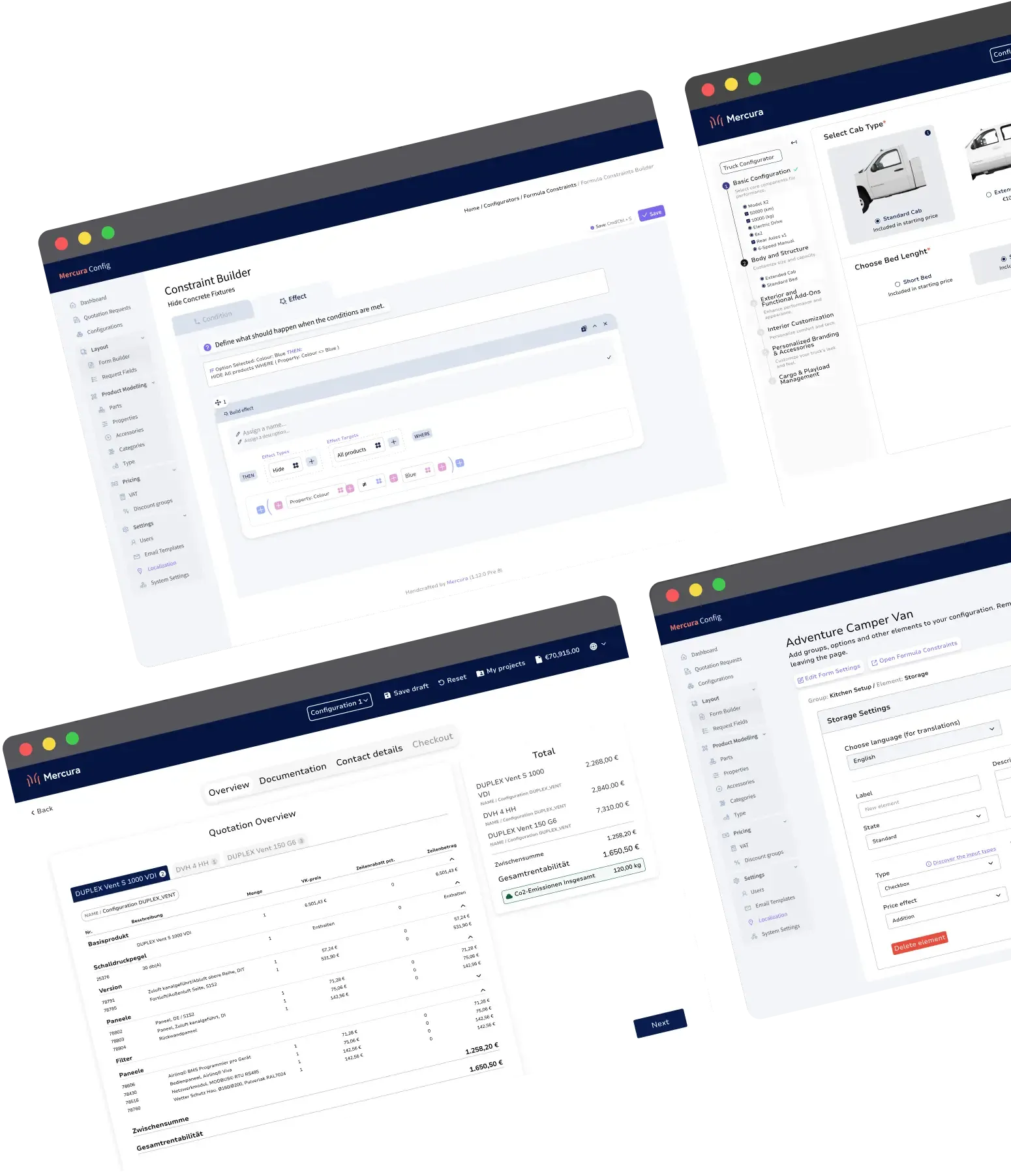
If selling your product means choosing options that change what can be built and what it costs, quote automation is not a document feature. It is the controlled path from a customer request to a buildable, priced offer, and then into the systems that fulfill it.
The Real Problem
The bottleneck is not the PDF
Most manufacturers already know how to export a proposal. The pain sits earlier: invalid configurations, waiting on engineering, inconsistent prices, and retyping the same deal into ERP.

Configuration before paper
A beautiful PDF with the wrong options is still a bad quote. Rules must decide what is allowed before any document is generated.

Engineering as a queue
Routine variants bounce to specialists because product knowledge lives in people and spreadsheets, not in shared rules sales can use.

Price and ERP drift
Even when the PDF looks right, the commercial logic may not match ERP costs, discount policy, or what production will actually build.
The Real Flow
The real quote flow
1. Request
A customer, dealer, or sales rep starts from a need, not from a blank spreadsheet. The request becomes a configuration session instead of an email thread.

2. Configuration
Options are selected in a guided interface. The goal is a product definition sales can stand behind, not a list of guesses for engineering to clean up later.
3. Rules
Product constraints decide what is buildable. Invalid combinations never reach the quote. This is where most “automation” products silently fail if they only decorate documents.

4. Price
Commercial logic runs on that valid configuration: base price, options, discounts, margin floors, ideally aligned with ERP and policy, not a private price file.
5. Document
Only then does a proposal or PDF get generated from the same state. Specs and price stay aligned because they share one source, the document is the output, not the system.
6. ERP
Accepted configurations hand off to order / ERP without retyping. Quote automation that stops at the PDF still leaves the expensive gap between sales and fulfillment.
What It Is Not
What quote automation is not
Useful to say out loud, because many tools market “quote automation” as prettier PDFs.

Not a PDF factory
Generating a branded PDF from a form is easy. Encoding product rules and pricing so the PDF is trustworthy is the hard part, and the only part that changes manufacturing sales.

Not a substitute for product modelling
If your catalog rules are unclear, automation will amplify confusion. Start by deciding what combinations are allowed; then automate the path around those rules.
Not only for marketing self-service
The same flow should work for direct sales and dealers. Channel-specific branding matters less than shared rules and pricing discipline.
Capabilities
What has to work end to end
For configurable-product manufacturers, these pieces have to stay connected.

Guided configuration with constraints
Sales and partners select options under the same rules engineering owns for standard product, so invalid combinations never become customer promises.

Pricing on the live configuration
Price updates as options change: base, uplifts, discounts, margin policy. No parallel spreadsheet that only one person trusts.
Proposal from the same state
The document is generated from the validated configuration. Templates and languages help; they do not replace correctness.

ERP and CRM hand-off
Connect pricing and product data where it lives, and push accepted configurations toward order handling without re-keying.

Approvals when policy requires them
Non-standard discounts or edge cases route to the right person. Standard, rule-valid quotes should not wait in the same queue.
Who Uses It
Same rules, different entry points
direct sales
Direct sales teams
Reps configure with the customer or after the call. Technical validation and pricing run in the session, engineering only sees exceptions.
dealer networks
Dealers and distributors
Partners quote with the same constraints and commercial logic as the factory. Support shifts from “explain every option” to “maintain the model.”
Outcomes
What changes when the flow is connected
Fewer invalid promises
Customers receive configurations that production can build, not options that only looked good in a PDF.
Shorter path to a real offer
Standard deals leave in one session when rules and price are in place. Time is spent on the deal, not on reconstructing known product.
Less rework into ERP
When the quote state is the hand-off, teams stop retyping specs and prices into order systems after the customer already said yes.
Integrates with your existing systems
Quote automation only sticks if configuration, price, and order data stay aligned with ERP and CRM, not if the PDF is a dead end.
FAQ
Frequently Asked Questions
Straight answers for manufacturers evaluating quote automation.
Isn't quote automation just generating a PDF?
No. A PDF is the last step. Real quote automation starts with a valid configuration, applies pricing rules, and keeps that state available for approvals and ERP, otherwise you automate the wrong layer.
Who is this for?
Manufacturers and distributors of configurable products options that change manufacturability and cost, where quotes today depend on specialists, fragile spreadsheets, or both.
How does this connect to ERP?
Product and pricing data can come from ERP, and accepted configurations can flow toward order handling so sales does not re-enter the deal after the proposal is signed.
Do we still need engineering?
Yes for new product, true one-offs, unmodeled BOM changes, and compliance sign-off. Automation removes the routine queue; it does not replace engineering judgment.
What about approvals and languages?
Approvals should catch policy exceptions, not every standard quote. Multi-language documents help international sales, after the configuration and price are already correct.
Request a CPQ demo